Have you ever woken up from a dream and wondered, “Why did I have this dream, and does it mean something deeper?” Dreams can feel mysterious, emotional, beautiful, frightening, or strangely familiar. Sometimes we remember every detail, while other dreams disappear within minutes of waking.
The spiritual meaning of dreaming about kinds of dreams can be understood in many ways. A dream may reflect your emotions, unresolved thoughts, personal growth, fears, hopes, or spiritual awareness. From a psychological perspective, dreams can process memories and feelings. From a spiritual perspective, they may symbolize inner transformation, intuition, guidance, or a deeper connection with your life path.
It is important not to treat every dream as a prediction. Instead, look at the emotions, symbols, people, places, and situations that appear. Your personal experiences often provide the most meaningful clues.
What Is the Spiritual Meaning of Dreaming About Kinds of Dreams?
The spiritual meaning of dreaming about kinds of dreams depends strongly on the type of dream and the feelings attached to it. A peaceful dream may symbolize emotional balance, while a disturbing dream may point toward something that needs attention in waking life.
Spiritually, dreams are often viewed as a doorway into the subconscious. They can bring hidden emotions to the surface and encourage you to notice things you may ignore during the day.
For example, dreaming about flying may represent freedom and personal expansion. Dreaming about being lost may symbolize uncertainty about your direction. A dream about water can relate to emotions, cleansing, or spiritual renewal.
Rather than asking only, “What does this symbol mean?” ask:
- What emotion did I feel during the dream?
- What is happening in my life right now?
- Did the dream remind me of someone or something?
- Was the dream peaceful, frightening, confusing, or inspiring?
- What lesson might this dream encourage me to consider?
These questions can help transform a confusing dream into a meaningful personal reflection.
Different Kinds of Dreams and Their Spiritual Symbolism
There are many kinds of dreams, and each can carry different emotional or spiritual themes. Understanding the general categories can help you interpret your own experiences.
Lucid dreams occur when you become aware that you are dreaming. Spiritually, they may symbolize increased self-awareness and conscious personal growth.
Recurring dreams happen repeatedly, sometimes with similar people, places, or situations. They may reflect an unresolved emotional issue or a lesson you have not fully processed.
Nightmares can represent fear, stress, insecurity, or emotional pressure. Spiritually, some people interpret them as invitations to face something they have been avoiding.
Prophetic-feeling dreams seem to correspond with later events. While such experiences can feel powerful, they should not automatically be treated as predictions. Coincidence, memory, intuition, and subconscious pattern recognition can also play important roles.
Healing dreams may bring feelings of comfort, forgiveness, reunion, or emotional release. They can symbolize the mind’s attempt to process pain and move toward acceptance.
Symbolic dreams use objects, animals, colors, people, or places to communicate emotional themes rather than literal messages.
The most important point is that dream symbols are personal. A snake might represent fear for one person but transformation or healing for another.
Spiritual Meaning of Recurring Dreams
Recurring dreams are among the most noticeable kinds of dreams because they return again and again. The spiritual meaning of dreaming about kinds of dreams that repeat may suggest that an emotional theme deserves your attention.
Imagine repeatedly dreaming that you are trying to reach a destination but cannot find the correct road. This could symbolize uncertainty about your career, relationships, identity, or future.
Another person may repeatedly dream about an old home. For them, the house might represent childhood, family memories, security, or a former version of themselves.
From a spiritual perspective, recurring dreams can be viewed as invitations to pause and reflect. They may encourage you to ask what remains unresolved.
You do not necessarily need to interpret the dream literally. Instead, focus on the repeated emotion. Are you afraid? Excited? Trapped? Lonely? Relieved?
The emotion may be more important than the dream’s storyline.
Psychological Perspective on Different Kinds of Dreams
Psychology provides another valuable way to understand dreams. Dreams can reflect memories, emotions, daily experiences, worries, desires, and information processed during sleep.
Dreams may combine unrelated memories into unusual stories. A person you have not thought about for years might suddenly appear because your mind connected that person with a current emotion.
Stress can also influence dreams. During periods of pressure, people may experience dreams involving falling, being chased, failing an exam, losing something important, or arriving somewhere too late.
This does not necessarily mean something supernatural is happening. It may simply show that your mind is processing emotional tension.
The psychological and spiritual perspectives do not always need to compete. You can use both. Psychology may explain how the dream was created, while personal spirituality may help you reflect on what the dream means to you.
Cultural Interpretations of Kinds of Dreams
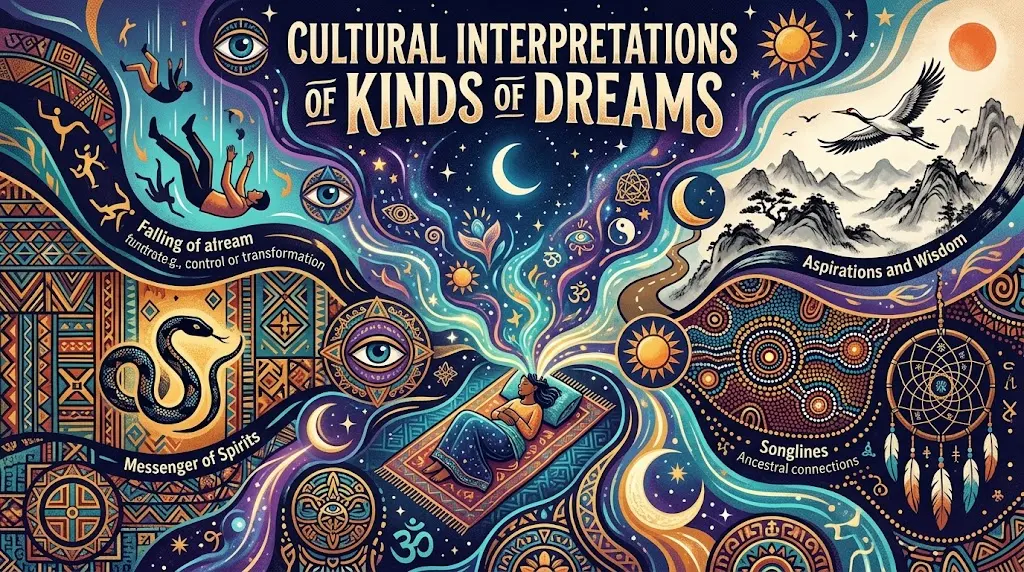
Throughout history, different cultures have given dreams special importance. Ancient civilizations often viewed dreams as messages, warnings, symbols, or connections to the divine.
In some traditions, dreams involving ancestors are interpreted as meaningful emotional or spiritual experiences. Dreams about water, animals, celestial objects, temples, journeys, or unusual lights have also received symbolic interpretations across cultures.
Islamic dream traditions distinguish between different types of dreams and emphasize that not every dream should be interpreted as a meaningful message. In Islamic thought, dreams can have different origins, and interpretation should be approached carefully rather than assuming every dream predicts the future.
Other cultural traditions may connect dreams with ancestors, nature, spiritual journeys, or collective symbolism.
Because interpretations vary, it is wise to avoid claiming that one symbol has exactly the same meaning for everyone. Your cultural background, beliefs, experiences, and emotional state can change how a dream feels and what it represents.
Kinds of Dreams Connected to Emotional Blockages
Dreams can sometimes reveal emotional tension that has not been fully acknowledged. If you constantly dream about being unable to speak, for example, you might reflect on whether you feel unheard in waking life.
Dreaming about being trapped could symbolize feeling restricted by circumstances. Dreaming about losing your belongings might reflect insecurity or fear of change.
These interpretations are not diagnoses. They are possibilities for self-reflection.
Consider the following emotional themes:
- Fear: You may be confronting uncertainty or vulnerability.
- Anger: You may have an unresolved conflict or suppressed frustration.
- Sadness: Your mind may be processing grief, disappointment, or loneliness.
- Joy: The dream may reflect hope, gratitude, freedom, or emotional fulfillment.
- Confusion: You may be uncertain about an important decision.
- Peace: You may be moving toward acceptance or emotional balance.
Your dream can become a mirror. It does not necessarily tell you what will happen; sometimes it simply shows you what is happening inside you.
Chakras and the Spiritual Meaning of Dreaming About Kinds of Dreams
Some spiritual traditions connect dreams with the chakra system. While chakras belong to spiritual and energetic traditions rather than established medical science, they can provide a reflective framework for understanding emotional themes.
Dreams involving the root chakra may symbolically relate to safety, stability, home, money, or belonging.
The sacral chakra is traditionally associated with emotions, creativity, relationships, and pleasure. Dreams involving water or intense emotional experiences may be explored through this lens.
The solar plexus chakra is connected in spiritual traditions with confidence, identity, and personal power. Dreams about winning, losing control, or confronting challenges may encourage reflection on these themes.
The heart chakra is associated with compassion, love, forgiveness, and emotional connection. Dreams involving loved ones, reunions, or emotional healing may resonate with this symbolism.
The throat chakra is traditionally linked with communication. Dreams where you cannot speak, scream, or express yourself may invite reflection about communication in waking life.
The third-eye chakra is associated with intuition and inner awareness. Vivid or highly symbolic dreams may be explored through this spiritual framework.
The crown chakra represents spiritual connection in many chakra traditions. Dreams involving light, profound peace, sacred places, or a sense of unity may feel significant to people who use this framework.
These interpretations should be treated as spiritual reflection rather than scientific fact.
Common Kinds of Dreams and What They May Reflect
Different dream experiences can point toward different emotional themes.
Dreams About Flying
Flying dreams are often associated with freedom, confidence, ambition, and the desire to rise above limitations. If the experience feels joyful, it may symbolize independence. If you are frightened while flying, it could represent anxiety about losing control.
Dreams About Falling
Falling dreams may occur during stressful or uncertain periods. Symbolically, falling can represent insecurity, fear of failure, or the feeling that something in life is outside your control.
Dreams About Water
Water frequently appears in dreams and is often associated with emotions. Calm water may symbolize peace, while turbulent water can represent emotional overwhelm.
Dreams About Being Chased
Being chased may reflect avoidance. Consider whether there is a problem, responsibility, conversation, or emotion you have been trying to escape.
Dreams About Death
Dreaming about death does not automatically mean that someone will die. Symbolically, death can represent endings, transformation, identity changes, or the beginning of a new chapter.
Dreams About Animals
Animals can represent instinct, personality traits, fears, strength, protection, or freedom. The specific animal matters, but your emotional response to it matters just as much.
Dreams About Houses
A house can symbolize the self, personal life, memories, or different aspects of your inner world. A damaged house might represent emotional instability, while a beautiful new house could symbolize growth or a fresh beginning.
Real-Life Examples of Dream Experiences
Consider someone named Sarah who repeatedly dreams that she is standing at a train station while a train leaves without her. She feels anxious every time. Instead of assuming the dream predicts a missed opportunity, she reflects on her life and realizes that she has been afraid of making an important career decision.
The dream may be expressing her fear of missing the right moment.
Now consider David, who dreams about swimming peacefully in clear water after experiencing months of emotional stress. He wakes feeling unusually calm. Spiritually, he may interpret the dream as a symbol of cleansing and renewal. Psychologically, it may represent his mind processing emotional tension.
Another person may dream about an old friend after many years. The dream could inspire memories of a happier period. Perhaps the friend represents not the actual person but qualities the dreamer misses, such as confidence, freedom, or companionship.
These examples show why personal context matters. The same symbol can mean very different things to different people.
How to Interpret Your Dreams Spiritually
If you want to explore the spiritual meaning of dreaming about kinds of dreams, begin by keeping a dream journal.
Write down the dream immediately after waking. Include the people, colors, locations, objects, emotions, and major events you remember.
Then ask yourself what was happening in your waking life around the same time.
Avoid forcing an interpretation. Instead, look for emotional connections.
You can also spend a few quiet minutes in reflection, prayer, meditation, or journaling according to your personal beliefs. Ask yourself what the dream may be encouraging you to notice.
Most importantly, do not allow a frightening dream to control your decisions. A dream can be meaningful without being a prophecy.
Why Do We Have So Many Different Kinds of Dreams?
The human mind is constantly processing information. During sleep, memories, emotions, sensations, and experiences can become connected in unusual ways.
This is one reason dreams can feel so strange. You may see your childhood home, a current friend, an unknown city, and a completely impossible event in the same dream.
Different kinds of dreams may arise from different combinations of memory, emotion, imagination, stress, and sleep processes.
Spiritually, some people see this dream activity as an opportunity for self-discovery. Instead of trying to decode every detail, focus on the bigger emotional message.
Sometimes the most valuable question is not, “What will happen?” but “What is this dream helping me understand about myself?”
FAQs About the Spiritual Meaning of Dreaming About Kinds of Dreams
1. What is the spiritual meaning of dreaming about different kinds of dreams?
The spiritual meaning can vary depending on the dream’s symbols, emotions, and personal circumstances. Dreams may encourage reflection, awareness, transformation, or emotional healing.
2. Do all dreams have a spiritual meaning?
No. Not every dream needs to have a spiritual meaning. Many dreams can result from memories, emotions, daily experiences, stress, or normal sleep processes.
3. Can recurring dreams have a spiritual meaning?
They can be explored spiritually as symbols of an unresolved emotional theme or personal lesson. However, recurring dreams can also result from repeated thoughts, stress, or memories.
4. Are dreams predictions of the future?
A dream should not automatically be considered a prediction. Even dreams that later seem connected to real events can have psychological, intuitive, or coincidental explanations.
5. How can I understand my dream better?
Write your dream down immediately after waking. Focus on the strongest emotion, identify important symbols, and consider what is happening in your current life. Personal context is often the most useful key.
Final Reflection on the Spiritual Meaning of Dreaming About Kinds of Dreams
The spiritual meaning of dreaming about kinds of dreams is not always found in one universal dream dictionary. Your dreams are shaped by your memories, emotions, beliefs, relationships, fears, hopes, and experiences.
A frightening dream may reveal something that deserves compassion rather than fear. A joyful dream may remind you of a quality you want to bring into your waking life. A recurring dream may encourage you to address something you have been avoiding. Even an ordinary dream can become meaningful when it inspires self-awareness.
When you wake from a powerful dream, pause before rushing into your day. Take a breath and remember what you felt. Write down what you can. Then gently ask yourself what part of your life the dream seems to reflect.
You do not need to force an answer.
Sometimes the meaning becomes clearer with time.
Let your dreams be invitations to understand yourself more deeply, while keeping your feet grounded in everyday reality. The most valuable dream interpretation is one that encourages wisdom, emotional awareness, personal growth, and peace.