
Have you ever woken up in the morning, stretched, looked around your room, and thought, “What does it mean when you don’t dream?” You may sleep for seven or eight hours, yet your nights seem completely blank. No strange places. No familiar faces. No mysterious conversations. Just darkness followed by morning.
For some people, this can feel unsettling. Dreams can seem like little windows into the subconscious, so when those windows appear closed, you may wonder whether something has changed inside you.
The truth is that not remembering dreams does not necessarily mean you are not dreaming. Most people dream during sleep, especially during REM sleep, but they may forget their dreams within minutes of waking. Still, from a spiritual perspective, periods of dreamlessness can feel meaningful. They may represent rest, emotional quietness, inner transition, or a season when your attention is being directed toward your waking life.
So, what does it mean when you don’t dream spiritually? There is no single answer. Your emotions, spiritual beliefs, sleep patterns, stress levels, and life circumstances all matter.
Sometimes the silence of your dreams is not an absence of guidance. It may simply be an invitation to become more present, listen more carefully, and allow your inner world to unfold naturally.
What Does It Mean When You Don’t Dream Psychologically?
From a psychological perspective, not remembering dreams is very different from not dreaming at all.
Dreaming is a normal part of sleep. However, dream memories are often fragile. If you wake up suddenly, check your phone, get out of bed quickly, or immediately start thinking about your responsibilities, the dream can disappear before you have time to remember it.
Stress and sleep quality can also affect dream recall. Changes in your sleeping schedule, exhaustion, medications, alcohol, or interrupted sleep may influence how clearly you remember your dreams.
Your brain may also prioritize information differently. Dreams are often forgotten because they are not always stored in long-term memory in the same way as important waking experiences.
Therefore, if you ask, “What does it mean when you don’t dream?”, psychology offers a simple possibility: you may still be dreaming, but you are not remembering those dreams.
This can be reassuring. A blank morning does not automatically mean that your subconscious has stopped communicating with you.
Sometimes the message is simply hidden beneath the surface of memory.
What Does It Mean When You Don’t Dream Spiritually?
Spiritually, dreamlessness can carry a different kind of symbolism.
Many spiritual traditions view dreams as a space where the conscious mind becomes quieter and deeper emotions, memories, symbols, and intuitions may emerge. Because of this, a period without remembered dreams may feel like a spiritual pause.
It can symbolize rest, stillness, surrender, protection, or transition.
Imagine a lake after a storm. During the storm, the water is constantly moving. Once the wind becomes quiet, the surface slowly becomes still. Your inner world can sometimes work in the same way.
Perhaps you have recently experienced emotional confusion. Maybe you have been making difficult decisions or thinking deeply about your future. A period of dreamlessness may represent a temporary quieting of your emotional landscape.
Spiritually, it can also encourage you to stop searching for signs everywhere.
Not every spiritual message arrives through a dramatic dream. Sometimes guidance appears through your feelings, relationships, repeated thoughts, unexpected opportunities, prayer, meditation, or simple moments of clarity during the day.
The absence of remembered dreams does not mean the absence of spiritual growth.
The Spiritual Symbolism of Dreamless Sleep
Dreamless sleep can symbolize several spiritual themes.
Rest and restoration may be the first message. Your mind and spirit sometimes need quiet rather than more information.
Surrender can be another interpretation. You may be entering a period where you cannot control every outcome. Instead of searching for answers, you may need to trust the process.
Transition is also possible. When one chapter of life is ending and another is beginning, your inner world may feel unusually quiet.
Emotional protection can sometimes be associated with dreamless periods. If you have been overwhelmed, your mind may need peaceful sleep instead of emotionally intense dream experiences.
Finally, dreamlessness may symbolize presence. You may be learning to focus less on what happens during sleep and more on what happens while you are awake.
The spiritual lesson may not be, “Look harder for a dream.”
It may be, “Pay attention to your life.”
What Does It Mean When You Don’t Dream About Anything?
When people say, “I don’t dream about anything,” they often mean that they wake up without any dream memories.
This can feel like sleeping inside a completely empty space. However, the experience itself may have emotional meaning.
If you feel peaceful about it, the dreamless period could simply represent mental rest.
If you feel anxious, it may reflect your desire for answers. You may be searching for reassurance about love, family, work, relationships, or your future.
If you feel frustrated, you might be expecting your dreams to solve a problem that needs attention in waking life.
Ask yourself:
- How do I feel when I wake up?
- Have I been under unusual stress?
- Am I sleeping deeply or waking frequently?
- Have my sleep habits changed?
- Am I searching for an answer that I already partly know?
- Do I feel emotionally peaceful or emotionally disconnected?
Your feelings may tell you more than the absence of a remembered dream.
Cultural Interpretations of Not Dreaming
Different cultures have developed different beliefs about dreams and dreamless sleep.
In many ancient traditions, dreams were considered meaningful experiences connected with ancestors, gods, spiritual guidance, or hidden knowledge. Because dreams were valued, the absence of remembered dreams could sometimes be interpreted as a period of spiritual quiet.
In some spiritual traditions, silence itself is considered meaningful. Not receiving a symbolic message may encourage patience rather than fear.
In Islamic thought, dreams can be understood in different ways, and not every dream is treated as a spiritual message. A person may experience ordinary thoughts, meaningful dreams, or disturbing experiences during sleep. Therefore, having no remembered dream does not automatically carry a negative spiritual meaning.
Across cultures, one common theme appears: dreams should not always be forced into a specific interpretation.
A dream may be meaningful, but so can peaceful sleep.
Your personal beliefs and circumstances should therefore guide your interpretation rather than a rigid dream dictionary.
What Does It Mean When You Don’t Dream About Someone You Love?

Sometimes people become concerned when they stop dreaming about someone important.
You may think, “I used to dream about this person all the time. Why don’t I anymore?”
This does not necessarily mean that your relationship has changed or that the person has spiritually disappeared from your life.
Dream frequency can naturally change. Your brain may process memories differently over time. Emotional intensity can also rise and fall.
Spiritually, however, the change may feel symbolic.
Perhaps you are becoming less emotionally dependent on that person. Maybe you are healing from an old attachment. You could also be entering a new stage in the relationship where you no longer need dreams to feel connected.
If the person has passed away, the absence of dreams can sometimes feel especially painful. But not dreaming about someone does not mean you have forgotten them.
Love does not depend on dream appearances.
Memories, lessons, prayers, emotions, and shared experiences can remain meaningful even when dreams become quiet.
What Does It Mean When You Don’t Dream About Your Future?
Dreams are sometimes interpreted as glimpses of the future, but there is no reliable rule that says dreams must predict what will happen.
If you have stopped dreaming about your future, goals, marriage, career, or personal journey, do not assume that your path has become blocked.
Instead, consider whether you are becoming more grounded in the present.
Sometimes we spend so much energy asking, “What will happen next?” that we forget to ask, “What can I do today?”
Spiritually, dreamless nights may encourage you to release the need to know everything in advance.
Your life path does not need to be revealed all at once.
Some answers arrive through action.
Some arrive through patience.
Some arrive only after you have walked far enough to understand why the earlier path was necessary.
What Does It Mean When You Don’t Dream During a Spiritual Awakening?
A spiritual awakening is often imagined as a period filled with vivid dreams, strange symbols, synchronicities, and powerful emotions. But spiritual growth does not always look dramatic.
Some people may experience vivid dreams during periods of personal change. Others may experience quiet sleep.
If you are asking what does it mean when you don’t dream during a spiritual awakening, consider the possibility that your growth is happening through awareness rather than nighttime symbolism.
You may be becoming more conscious of your thoughts.
You may be changing your values.
You may be releasing old habits.
You may be becoming more compassionate toward yourself.
You may simply be learning to trust uncertainty.
Spiritual development does not require constant supernatural experiences. Sometimes the deepest growth happens quietly.
Chakras and Emotional Blockages Behind Dreamless Sleep
Some spiritual systems connect dreams with the upper chakras, particularly the third-eye chakra and crown chakra.
The third-eye chakra is traditionally associated with intuition, inner vision, imagination, and perception. The crown chakra is often connected with spiritual awareness, contemplation, and a sense of connection.
From this symbolic perspective, difficulty remembering dreams may encourage you to explore how connected you feel to your intuition.
Ask yourself whether you have been ignoring your inner voice.
Are you constantly distracted?
Do you rarely spend time alone?
Do you immediately reach for your phone after waking?
Have you been emotionally overwhelmed?
These questions can be more useful than assuming that a blocked chakra is definitely causing dreamlessness.
You can create a gentle nighttime routine through meditation, prayer, journaling, deep breathing, or quiet reflection. These practices may help you become more aware of your thoughts and dreams without forcing a particular spiritual outcome.
The goal is not to make yourself dream.
The goal is to become more present.
What Emotional Blockages Can Dreamlessness Represent?
Dreamlessness can sometimes feel emotionally symbolic when you are going through a difficult period.
For example, emotional exhaustion may create a strong desire for mental silence. You may spend the entire day processing problems, responsibilities, and conversations. At night, you simply want rest.
Another possibility is emotional avoidance. If you have been pushing difficult feelings aside, you might wonder why your inner world feels inaccessible.
But be careful not to treat this as proof of an emotional blockage. Dream recall varies naturally from person to person.
Instead, use the experience as an opportunity for self-reflection.
Ask:
“What am I avoiding during the day that I wish I could understand at night?”
That question can open a meaningful conversation with yourself.
Real-Life Examples of What Does It Mean When You Don’t Dream?
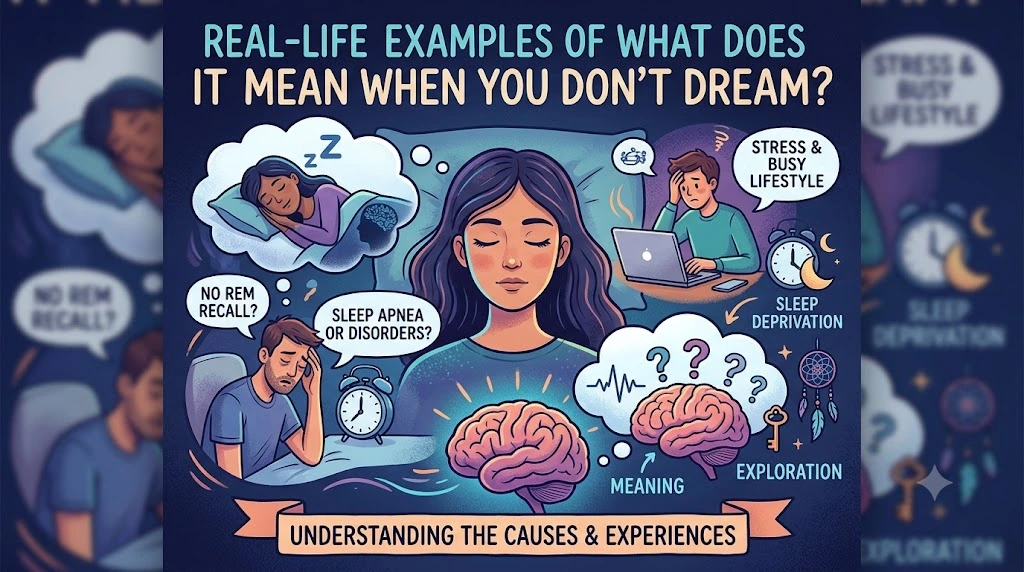
Consider someone who recently ended a relationship. For months, they dreamed about their former partner almost every week. Then suddenly, the dreams stopped.
At first, they felt worried. Later, they realized that they were no longer thinking about the relationship every day. The silence of their dreams reflected a change in emotional attention.
Another person may be under intense academic or work pressure. They sleep deeply but remember nothing in the morning. Once their schedule becomes calmer, their dream recall returns.
A third person may begin a spiritual practice and expect increasingly vivid dreams. Instead, they experience peaceful nights with little dream memory. Rather than seeing this as failure, they begin focusing on meditation, gratitude, and daily awareness.
These examples show why there is no universal answer to what does it mean when you don’t dream.
The meaning depends on your emotional landscape.
How to Remember Your Dreams Again
If you want to improve dream recall, you can gently train your attention.
Keep a notebook beside your bed. When you wake up, stay still for a few moments. Before reaching for your phone, ask yourself what you were feeling or seeing just before waking.
Even a tiny detail matters.
You may remember a color, a face, a room, a sound, or simply an emotion.
Write it down immediately.
You can also create a consistent sleep schedule and give yourself enough time to sleep. A calm bedtime routine may help you become more aware of your sleep experiences.
Most importantly, do not pressure yourself.
Dream recall often improves when you approach it with curiosity rather than anxiety.
FAQs About What Does It Mean When You Don’t Dream?
1. What does it mean when you don’t dream at all?
Usually, it means you do not remember your dreams. Most people experience dreaming during sleep, but dream memories can disappear quickly after waking. Stress, sleep patterns, and interruptions can also influence recall.
2. Is not dreaming a bad spiritual sign?
Not necessarily. Spiritually, a dreamless period can symbolize rest, stillness, transition, or a need to focus on waking life. It should not automatically be interpreted as a negative sign.
3. Why have I suddenly stopped remembering my dreams?
Changes in sleep quality, stress, daily routines, waking patterns, substances, or medications can influence dream recall. Sometimes there is simply a natural change in how strongly dreams are remembered.
4. Does not dreaming mean my third-eye chakra is blocked?
There is no scientific evidence that dream recall directly proves a chakra is blocked. In spiritual practice, however, you can use reduced dream awareness as an invitation to explore intuition, mindfulness, and inner reflection.
5. Can dreamless sleep have a spiritual meaning?
Yes, if you personally find spiritual symbolism meaningful. It can represent peace, surrender, emotional rest, or a transition into a quieter stage of personal growth. However, there is no single spiritual interpretation that applies to everyone.
Conclusion
So, what does it mean when you don’t dream? Sometimes it means you are dreaming but simply do not remember. Sometimes it reflects changes in your sleep, stress, emotions, or daily routine. From a spiritual perspective, it may also symbolize a quiet season in your life—a time when you are being invited to rest rather than search for answers.
Do not be afraid of the silence.
Your inner world does not become empty simply because you cannot remember what happened during the night. Your growth can continue quietly. Your intuition can speak through waking moments. Your emotions can reveal themselves through everyday experiences.
If your dreams have disappeared from memory, let yourself rest.
Keep a journal if you feel drawn to it. Pray, meditate, reflect, and pay attention to your emotions. But do not force a message to appear.
Sometimes the most meaningful spiritual lesson is learning that you do not need an answer immediately.
A quiet night can still be healing.
A blank dream can still be peaceful.
And sometimes, when nothing seems to happen in your dreams, life is simply giving you space to listen to what is happening within you while you are awake.